
Food Truck Guide
How to Brand a Food Truck in Miami: The Complete Wrap Guide
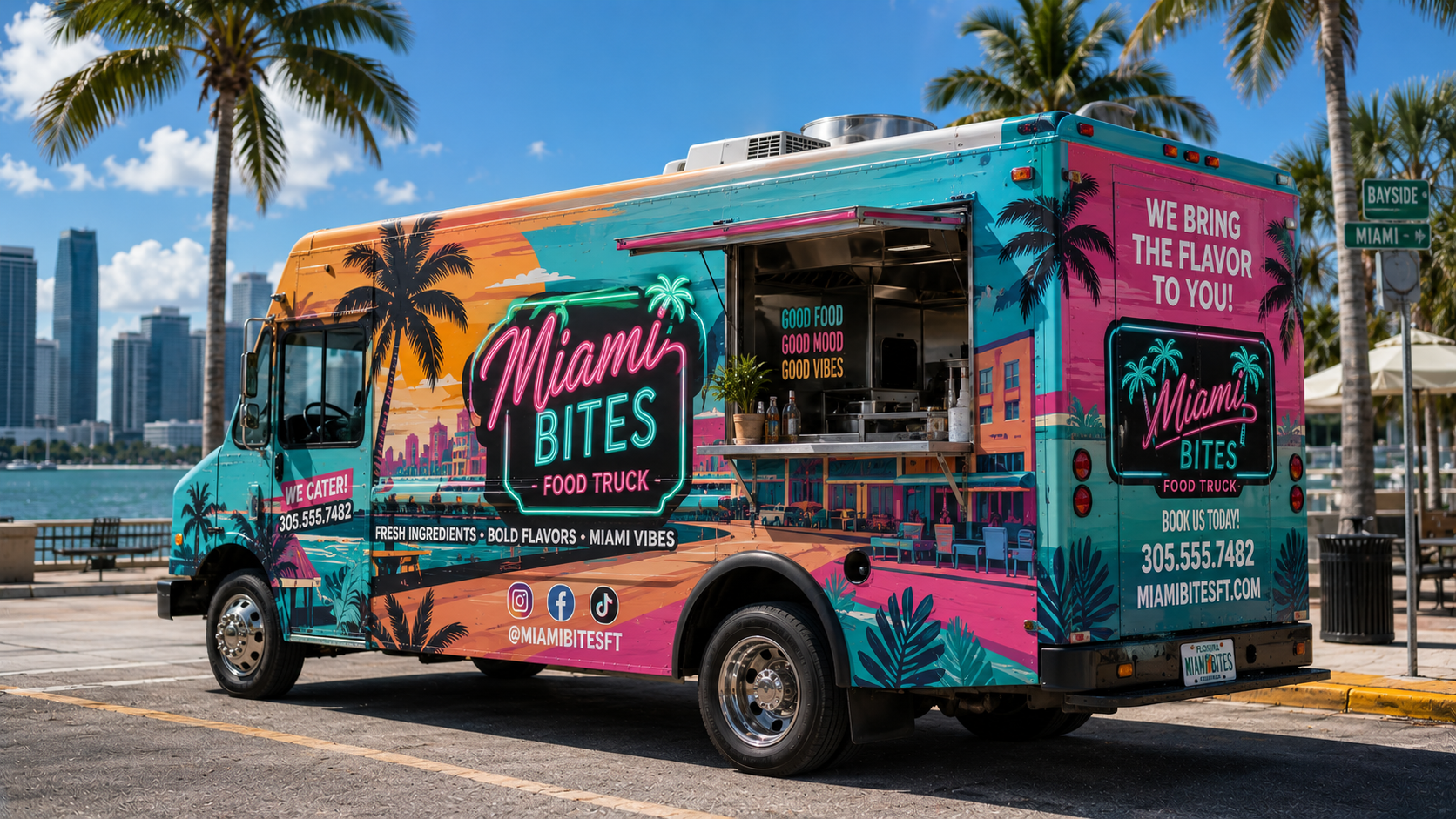
Miami’s food truck scene is one of the most competitive in the country. From Wynwood art walks to Brickell lunch rushes and weekend festivals in Hialeah, your truck is out there competing for attention against dozens of others. A professionally wrapped food truck isn’t just branding — it’s your most valuable marketing asset on wheels.
Why It Matters
Your Truck Is a Rolling Billboard
A food truck operating in Miami gets seen by thousands of people every day — in traffic, at events, parked at a corner in the Design District. Studies show a single vehicle wrap generates between 30,000 and 70,000 impressions per day in a dense metro environment. At that volume, a wrap pays for itself in brand awareness faster than almost any other marketing channel.
The problem is most food truck operators underestimate what goes into a good wrap. They pick a template, slap a logo on it, and wonder why it doesn’t stand out at a crowded food truck rally. Great food truck branding starts long before vinyl hits the vehicle.
Step 1
Define Your Visual Identity First
Before any design work begins, you need to nail down three things: your color palette, your typography, and your hero image or graphic element. These will define every square inch of your wrap.
What to lock down before calling a wrap shop:
- ✔ Primary brand color (1–2 colors max for maximum impact at distance)
- ✔ Logo in vector format (.ai or .eps — not JPG)
- ✔ A clear tagline or category identifier ("Tacos" / "BBQ" / "Vegan Bowl")
- ✔ A hero visual — food photography, illustrated mascot, or bold pattern
- ✔ Your social handle and website (both must be readable at 20 feet)
Miami’s best-performing food trucks tend to use bold, saturated colors — electric yellow, neon green, deep red — that pop against the city’s bright natural light. Pale palettes wash out in Florida sun.
Step 2
Design for the Miami Environment
Not all wraps are designed for South Florida conditions. Miami’s combination of intense UV exposure, humidity, salt air (especially near the coast), and frequent rain means your wrap material and laminate choice matters enormously.
At Wraptors, we use 3M IJ180Cv3 and Avery MPI 1105 cast vinyl with a UV-resistant gloss or matte laminate on all food truck projects. Cast vinyl conforms to the contours of a truck body — around rivets, handles, and panel seams — without lifting or bubbling in the heat. Calendered vinyl is cheaper but will fail within 2 years in this climate.
Pro tip: If your truck operates near the beach (Miami Beach, Key Biscayne, Coconut Grove waterfront), specify a marine-grade laminate. Salt air accelerates edge lifting on standard laminates, especially around door seams and lower panels.
Step 3
Plan the Wrap Layout Around Your Truck’s Shape
Food trucks come in wildly different configurations — step vans, Sprinters, trailers, converted school buses. Each has a different panel structure, window placement, and service window location that must be incorporated into the design.
A good wrap designer will work from a vehicle-specific template — not a generic truck outline. At Wraptors, we measure every vehicle before the design phase starts. Common mistakes we fix when clients come to us after a bad experience elsewhere:
- Logo placed behind the service window (invisible when it’s open)
- Key information on the driver’s side where foot traffic never sees it
- Text running across body seams, creating a misregistered look
- Ignoring the roofline — highly visible in Miami’s multi-story urban areas
The passenger side and rear of your truck typically get the highest pedestrian visibility at events. Your brand name, category, and contact info should be prioritized there.
Step 4
The Install Process for Food Trucks
Food truck installs are more complex than standard vehicles. The ribbed panels on step vans require aggressive heating and manipulation during application. Rivets need to be individually relief-cut and wrapped. The service window area needs precise trimming so the wrap doesn’t interfere with operation.
Plan for 2–3 days off the road for a full truck wrap. At our Doral studio, we handle the prep, print, and install in-house — no outsourced panels, no third-party print shops.
Typical food truck wrap timeline:
Step 5
What It Costs to Wrap a Food Truck in Miami
Pricing varies based on truck size, complexity, and material selection. Here’s a realistic breakdown for the Miami market:
Design fees are included in the project cost at Wraptors. See our full pricing guide →
FAQ
Food Truck Wrap Questions
How long will a food truck wrap last in Miami?
With cast vinyl and UV laminate, expect 4–6 years of quality appearance. Florida’s climate is harder on wraps than most states. Full wrap longevity guide here →
Can I wrap a truck I’m still making payments on?
Yes. Vinyl wraps are removable and do not damage the underlying paint if installed and removed correctly. Lenders typically have no objection.
Can you wrap just one side of a food truck?
Yes. Partial wraps are a cost-effective option. We can wrap the service side and rear fully, and do a simpler treatment on the driver side. Typically 40–50% of the cost of a full wrap.
Get Started
Ready to Brand Your Food Truck?
We’re based in Doral — 10 minutes from the heart of Miami’s food truck corridor. Bring your truck in for a free measurement and quote.
Related Industries